
AI-based business models
Yesterday, I was doing a webinar for the European Microfinance Network on the types of AI-based business models.
The key theme was that there are basically two different approaches:
- Renting intelligence via APIs
- Developing proprietary models
Some might refer to an operating model, but the choice of architecture fundamentally defines the key characteristics of the business model. There are differences in terms of customizability, latency, data privacy, transparency and dependency. It also impacts the uniqueness of the value proposition.
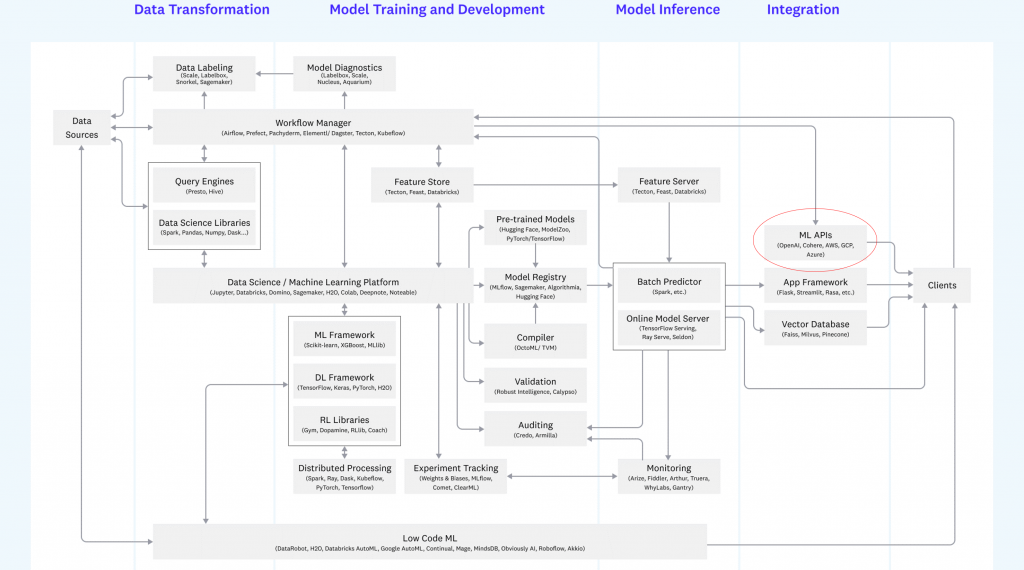
The figure below illustrates the blueprint for modern data infrastructure, based on research by a16z.
Renting intelligence
The first category involves renting intelligence.
Costs in this domain have decreased significantly in just a few months. For instance, while a model like gpt-4-32k-0314 cost $120 per 1 million tokens in early 2024, a model such as GPT-4.1 nano has an output costs of $0.40 per 1 million token.
Although direct model comparisons are difficult, we see costs decreasing significantly within months. These costs are fundamentally bounded by electricity expenses on the lower end and by competitive market forces on the upper end. The table below shows the cost of using some of the standard LLM models from OpenAI, Anthropic, Mistral, xAI and Google.

Let me put these numbers in perspective. A general rule of thumb is that 1 token equates approximately 0.75 words. That means that a typical book with a length of 50,000 words is equivalent to approximately 70,000 tokens. Consequently, you could input 14 books for a total cost of $0,15 when you are using Gemini 2.5 Flash.
These models make perfect sense for all concepts which rely on text. Think of all examples which offer therapy, education or the creation of text.
Wysa is offering mental health services and outlines the use of OpenAI in its terms of use:
Wysa+ GAI Service is the next generation of the Wysa conversation chatbot. This integrates advanced AI models like third-party external or on-premise LLM (large language models) to provide you with even more personalized conversations and recommendations tailored to your needs. Presently, Wysa+ GAI Service uses a combination of third-party OpenAI API generated output and our own proprietary rule-based content to provide the service.
In the education sector, Khanmigo, a part of Khan Academy, is offering services for students. A study titled „An Evaluation of Khanmigo, a Generative AI Tool, as a Computer-Assisted Language Learning App” by Shamini Shetye assessed the quality. At the time of the study, the platform was using GPT-4 and the results were somewhat mixed. The best approaches how AI can be used in education still need to be assessed.
Another example is speech to text. Microsoft is offering Azure AI Speech these service via Azure and has the following prices.
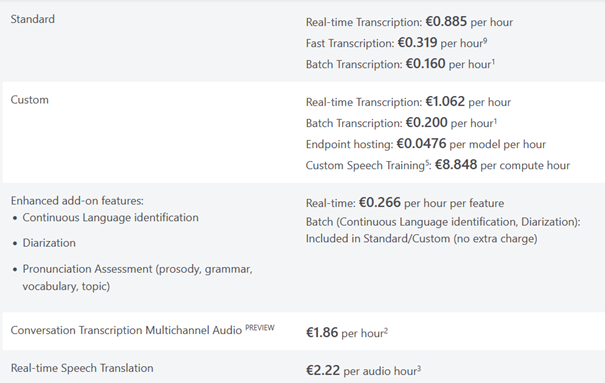
I can still remember how expensive it used to be hire freelancers to transcribe interviews. Given the prices, new use cases are becoming available for impact enterprises. For example, 60db is experimenting with AI interviewers in initial studies.
Developing proprietary models
Consumers are most familiar with the platforms like ChatGPT, Gemini or Grok. However, a lot of development is happening less visibly under the surface.
For example, Hugging Face hosts more than 1.7 million models which are available for download. These models cover different topics such as image-text-to-text, image classification, text classification or automatic speech recognition. Additionally, Hugging Face hosts more than 400,000 datasets.
This approach makes sense in a number of settings:
- Access to a high-quality dataset
- The output of the model is the main product
- There are no foundational models available
SkinVision is a Dutch enterprise which offers services to identify skin cancer. The development of proprietary models makes sense as their main asset is the collection of pictures showing problematic skin lesions. So far, they have performed 5 million checks, and each image helps to improve the quality of the underlying model. The technology is based on image processing as well as image recognition and analysis using Convolutional Neural Networks.
In an early study they have found that the app has a sensitivity of 95%. The app is good at correctly identifying skin lesions that are indeed problematic. Only 5 out of 100 would be missed (a false negative). The app has a specificity of 78% which means that the app is fairly good at correctly identifying skin lesions that are not problematic. The number means that if 100 people with a harmless skin lesion used the app, it would correctly identify the lesion as not concerning for approximately 78 of them. 22 would be incorrectly flagged as potentially problematic (false positive).
We have other examples in agriculture, or speech to text for persons with speech disabilities or impairments resulting from conditions such as cerebral palsy, stroke, ALS, Parkinson’s disease, or other speech-affecting conditions.
In conclusion, the landscape of AI-based business models is primarily defined by two distinct approaches: renting intelligence via APIs and developing proprietary models. The choice depends on data and model availability, privacy concerns as well as the long-term revenue plans.