
The role of the Entertainment TV industry
Let me start with a couple of observations about the newspaper industry.
The great unbundling: Historically, news media organizations were a „bundle“ of offers. A single newspaper provided news, sports, entertainment, horoscopes, classifieds and TV programs. Over time, internet dynamics drove the „unbundling“ of these services. Today, readers get Brussels updates from newsletters, political gossip via X (Twitter), crosswords via apps and local events through social media. This shift has been occurring since the launch of Craigslist in 1995.
The reduction of quality: Reduced advertising revenues as well as a loss of readers forced newspapers to reduce the quality of their offers as outlined in various research papers. Obviously, there are differences in terms of quality and the format of the news.
The reality of zero cost of content creation: The launch of LLMs and their rapid improvement in terms of quality means that we live in a world where researching information as well as writing text is basically free.
What is the current situation for television?
Unbundling: We can observe a similar unbundling of offers with the launch of video-based platforms like YouTube or TikTok. Market shares are going back, but it is quite remarkable that the total view time stayed constant at 225 minutes over the last 10 years. The numbers are from the Austrian Moving Image Study 2025 (Bewegtbildstudie) and – obviously – there are nuances in terms of age groups and formats. However, TV remains a strong format. For the non-German speakers: The illustration shows the share of different formats (linear TV in the first column) over time and the minutes of video consumption per day in the last column.
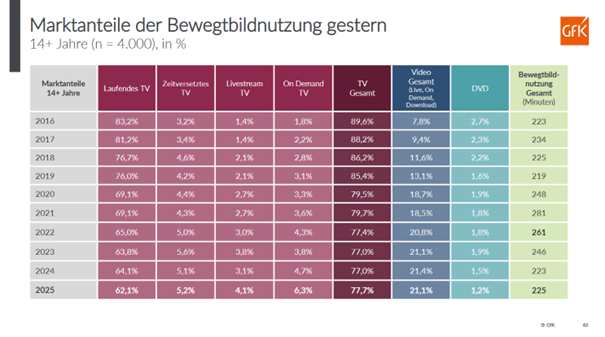
Quality: There are no real indicators measuring the quality of TV content but the popularity of TV means that this is not really an issue and Public Service Media frameworks or the Public Interest Mandate seem to be valuable as gatekeepers. However, public perception is usually contrary in the sense that entertainment TV carries a poor reputation.
The BBC uses four Drivers of Public Value
- Individual Value: Does the content inform, educate or entertain the specific viewer?
- Citizen Value: Does the content contribute to the social cohesion, cultural identity or democratic health of the nation?
- Economic Value: Does the content support the creative economy (e.g., by employing local talent)?
- Net Public Value: Does the value provided outweigh the market impact (i.e., does it unfairly compete with commercial providers)?
The US Public Broadcasting Service (PBS) explicitly defines quality through the lens of „Editorial Integrity“ with a focus on editorial independence, accuracy, fairness, transparency, inclusiveness, accountability
Zero cost of content: The following clip lasts 14 seconds and was created in less than 10 minutes using Nano Banana, Veo 3.1 and Da Vinci.
[add video]
Impact of TV
The really interesting question which is also under-researched is how TV contributes to social change. One of my all-time favorite charts is the career of social problems developed by Michael Schetsche and I used it quite frequently in seminars. I haven’t found the English version but it is relatively easy to understand.
It has two main messages:
- Social problems only exist when someone is speaking about it.
- The general public needs to be aware of social problems before any actions can be taken.
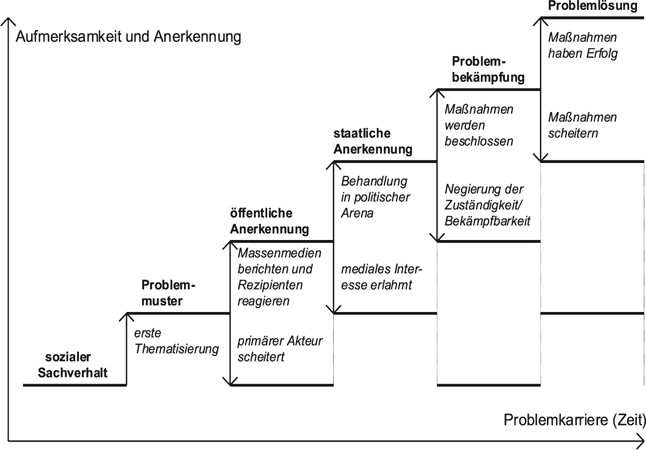
That also means that someone needs to take about social problems that they can be covered in the wider public. In my view, it is TV which plays a key role in this diffusion by accelerating cultural diffusion, influencing norms and reinforcing large-scale societal organization
There are countless examples how TV has helped to increase societal acceptance and covers topics such as life with cancer, syphilis outbreaks, safer sex, environmental risk, social problems and the list goes on. There is even a bible-themed book on “TV Shows That Teach: 100 TV Moments to Get Teenagers Talking”.

It will be interesting to see how the Entertainment TV industry will be developing and how the ability to act as a cultural gatekeeper transforming social problems into public conversations endures.